
The Biggest Revenue Lever Most Teams Ignore
Welcome to The RevOps Leader, where every week, we listen to dozens of ReVOps podcasts and extract the top actionable ideas. (For more context on these ideas, give the podcasts a listen).
Learn AI from RevOps builders. We're launching AI Skills workshops to help you understand trends, build custom tools, and automate workflows (taught by the CTOs / Heads of AI building AI tools in your industry, not trainers).
Reply “Skills” to save your spot as a Founding Member (the first 100 get 50% lifetime discount).
In this issue:
Your biggest revenue lever isn't your top OR your bottom performers – it's the middle 60%
How Zapier restructured RevOps to balance the tension of experimentation vs. exploit (building scalable foundations)
“The first 90 days” playbook for solo RevOps hires
1. Your biggest revenue lever isn't your top OR your bottom performers – it's the middle 60%
RevOps AF podcast: The Movable Middle: Your Hidden Revenue Lever (1/16/26)
TLDR:
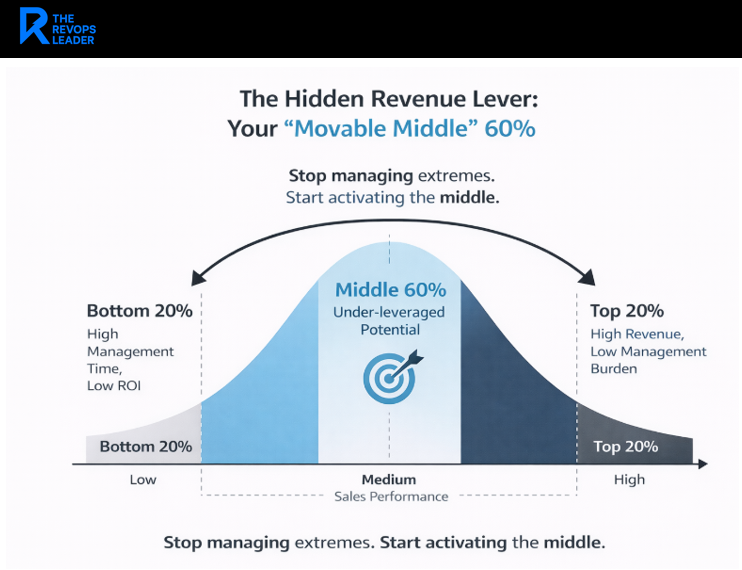
Companies waste massive time managing bottom 20% performers while ignoring the "movable middle" 60% where real ROI exists.
The winning formula: learn what top performers do, then make it unavoidable (not optional) for the middle 60%.
Training doesn't change behavior. Embedding best practices into the actual customer workflow does.
Ross Rich spent years as an enterprise sales rep and leader before founding Accord. His observation: companies obsess over their top 20% and bottom 20% while ignoring the 60% in the middle where the biggest revenue gains actually live.
The math problem hiding in plain sight
Your top 10-20% of reps drive 70-80% of revenue. Your bottom performers take up enormous management time but contribute almost nothing. Meanwhile, your middle 60% – the reps who are competent but not exceptional – represent your greatest untapped opportunity.
The trap most organizations fall into is spending disproportionate time with bottom performers, hoping coaching will turn them around.
But as Rich points out, these individuals typically either lack the skills or the motivation to succeed in your specific environment. That time investment rarely pays off.
Study the winners, then make their behaviors unavoidable
Top performers are often "unconsciously competent." They do things that work without necessarily knowing why.
Rich's recommendation: deeply study what your best reps actually do with customers (not what they say they do), then operationalize those behaviors for everyone else.
For instance, if your data shows that deals with fewer than three stakeholders have an 80% lower win rate, don't just train people on multi-threading. Build it into the workflow so progressing a deal requires documenting multiple contacts. Make the right behavior the path of least resistance.
This is fundamentally different from creating playbooks that live in a folder somewhere. The distinction: playbooks are things reps study, while embedded workflows are where deals actually get done.
Why training fails and workflows win
Think about your own experience with corporate training. Mock negotiations in a conference room never feel as visceral as actual customer conversations where your commission is on the line. The classroom teaches concepts; real customer interactions teach skills.
Rich's advice: spend your calories building the right processes into actual accounts and opportunities rather than theoretical training environments. If you want reps to build business cases, make it part of how they advance deals, and not a slide they saw in onboarding.
The bottom line
Stop wasting leadership bandwidth on your bottom 20%. Instead, invest that time understanding exactly what your top performers do differently, then restructure workflows so those behaviors become unavoidable for your middle 60%. That's where the real revenue leverage lives.
2. How Zapier restructured RevOps to balance the tension of experimentation vs. exploit (building scalable foundations)
RevOps Lab podcast: How AI is changing RevOps - with Lindsay Rothlisberger, Head of RevOps, Zapier (1/18/26)
TLDR:
Zapier's RevOps team shifted from functional silos (email ops, campaign design) to funnel-focused pods where individuals own specific parts of the customer journey.
The "explore vs. exploit" tension is real: RevOps must balance building scalable foundations with rapid experimentation.
The biggest untapped RevOps advantage isn't technical skill—it's organizational context that lets you see bottlenecks across the entire funnel.
Lindsay Rothlisberger has led RevOps at Zapier for six years, growing from the first marketing ops hire to heading a function that spans PLG and enterprise sales motions. Her recent insight: traditional RevOps structures can't keep pace with how quickly go-to-market is evolving.
From functional roles to funnel ownership
Zapier's old structure had marketing ops team members sharing responsibilities: one person handling lead management, another focused on email infrastructure, another on campaign design. The problem? No one truly owned funnel performance.
The new structure assigns team members to specific funnel segments.
One person obsesses over inbound performance and works in a pod with marketing counterparts to run experiments and improve conversion.
Another focuses entirely on outbound, pairing with the emerging "GTM engineer" function to orchestrate signals, enrichment, and outreach.
This isn't just reorganization for its own sake. It enables different working modes for different challenges.
Foundational work (data precision, system reliability, self-service analytics) requires rigor. Experimentation work (testing offers, validating new audiences, optimizing messaging) requires speed and tolerance for imperfection.
The "explore vs. exploit" tension every RevOps leader faces
Rothlisberger frames it as "explore vs. exploit" and argues that RevOps teams have typically over-indexed on exploit (scaling what works, driving predictability) while underinvesting in explore (experimentation, moving fast, testing hypotheses).
The reality of modern go-to-market demands both. Outbound is harder than ever. The right message to the right person at the right time matters more than volume. That requires rapid experimentation. But you also need reliable foundations to know what's actually working.
Her team's solution: explicitly separate the two modes. Some people focus on precision and scale. Others are empowered to move fast, create technical debt, and break things… as long as they're working toward clear goals.
Unstructured data is your next competitive advantage
Beyond org structure, Rothlisberger highlights an underutilized opportunity: mining unstructured data from call transcripts and email threads. Most RevOps teams focus on structured CRM data while ignoring the goldmine in conversation logs.
For example: analyzing call recordings to surface the top objections that aren't captured in standard loss reasons. Or processing email threads to identify patterns in what content actually resonates with buyers. LLMs make this feasible in ways that weren't possible two years ago.
One company discovered their biggest renewal blocker wasn't pricing or product fit; it was how their customers' accounting teams handled advertising budgets. That insight never would have surfaced from structured data alone.
The bottom line
RevOps organizational context – seeing bottlenecks across marketing, sales, and CS – is your biggest competitive advantage. Structure your team around funnel ownership rather than functional tasks. Explicitly separate "explore" work from "exploit" work. And start mining your unstructured data for insights your dashboards will never show.
3. “The first 90 days” playbook for solo RevOps hires
Webinar: Building an early RevOps foundation with Chris Morris, Account Strategist at accelant (1/16/26)
TLDR:
When joining a low-maturity RevOps environment, diagnose before you build. Rushing to change things destroys trust and kills adoption.
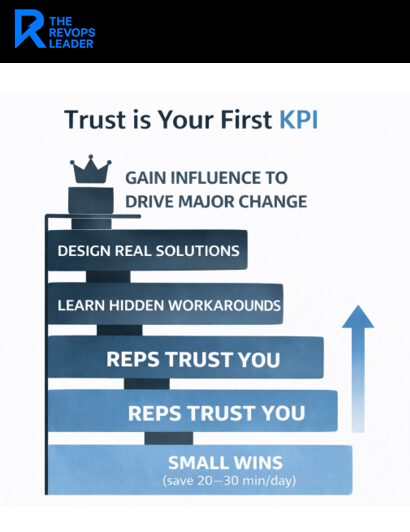
Start with quick wins that save sellers 20-30 minutes daily to earn credibility before tackling larger initiatives.
Less is more: overengineering processes early creates bottlenecks and causes reps to just "check boxes" rather than provide real data.
Chris Morris has spent 15 years building RevOps functions from scratch. His observation: most solo RevOps hires fail not because they lack technical skills, but because they rush in like a bulldozer without understanding what actually exists.
The four-phase framework: diagnose, design, deploy, iterate
Morris uses a simple mental model for entering any new RevOps environment:
Diagnose first. Understand current state before changing anything. What tech exists? What does the buyer journey look like? Most importantly: what are the shadow processes, the things people do that leadership doesn't know about? Some shadow processes reveal best practices worth scaling. Others exist only because better options don't.
Design second. Once you understand reality, build a roadmap. Identify quick wins for relationship building. Visualize the path from current state to future state in a way stakeholders can understand and contribute to.
Deploy third. Create MVPs of new workflows. Identify champions who can pilot changes and advocate across their teams. Support change management with communication, not just training.
Iterate always. After deployment, optimize. Find new applications. Adapt as the company's strategy evolves.
Quick wins build the trust that enables big changes
Saving a seller 20-30 minutes per day might seem trivial compared to your grand roadmap vision.
But those quick wins accomplish something critical: they build trust. Once reps see you as someone who makes their lives easier, they'll open up about what's really happening: the friction points, workarounds, and frustrations that aren't visible from dashboards.
Morris specifically recommends starting with low-hanging fruit that reduces friction between handoffs, increases conversion, or shortens deal cycles. Small visible improvements compound into organizational credibility.
Why overbuilding kills adoption
Early-stage RevOps requires restraint. Morris's principle: less is more. It's much easier to add complexity later than to strip it away.
Overcomplicating validation rules or requiring too many manual inputs creates bottlenecks where reps just enter garbage data to move deals forward.
Start simple. Track the handful of metrics that actually matter. As understanding deepens and strategy clarifies, add sophistication incrementally.
If you build something complex on day one, you'll likely rebuild it anyway… and burn adoption goodwill in the process.
The bottom line
Resist the urge to immediately implement your past playbook. Spend your first weeks deeply diagnosing current state and building relationships. Earn credibility through quick wins before proposing major changes. And remember: simpler processes adopted consistently beat sophisticated processes ignored.
Disclaimer
The RevOps Leader summarizes and comments on publicly available podcasts for educational and informational purposes only. It is not legal, financial, or investment advice; please consult qualified professionals before acting. We attribute brands and podcast titles only to identify the source; such nominative use is consistent with trademark fair-use principles. Limited quotations and references are used for commentary and news reporting under U.S. fair-use doctrine.
