
Every week, we listen to dozens of ReVOps podcasts and extract the top actionable ideas. (For more context on these ideas, give the podcasts a listen)
In this issue:
How the best GTM teams build “data recipes” (combinations of 1st-party data with 3rd-party signals)
RevOps 3.0: the evolution of RevOps from order-taker to systems builder
CROs often obsess over the wrong metrics (here’s how Intercom fixed it)
1. How the best GTM teams build “data recipes” (combinations of 1st-party data with 3rd-party signals)
Fireside chat with Manoj Ramnani (Founder & CEO, SalesIntel) and Mike Burton (Co-Founder, Bombora): What’s the Winning GTM Data Recipe in an AI-First World? (12/30/25)
TLDR:
Clean, complete data is the foundation of any AI-powered go-to-market motion; without it, automation just scales your mistakes faster
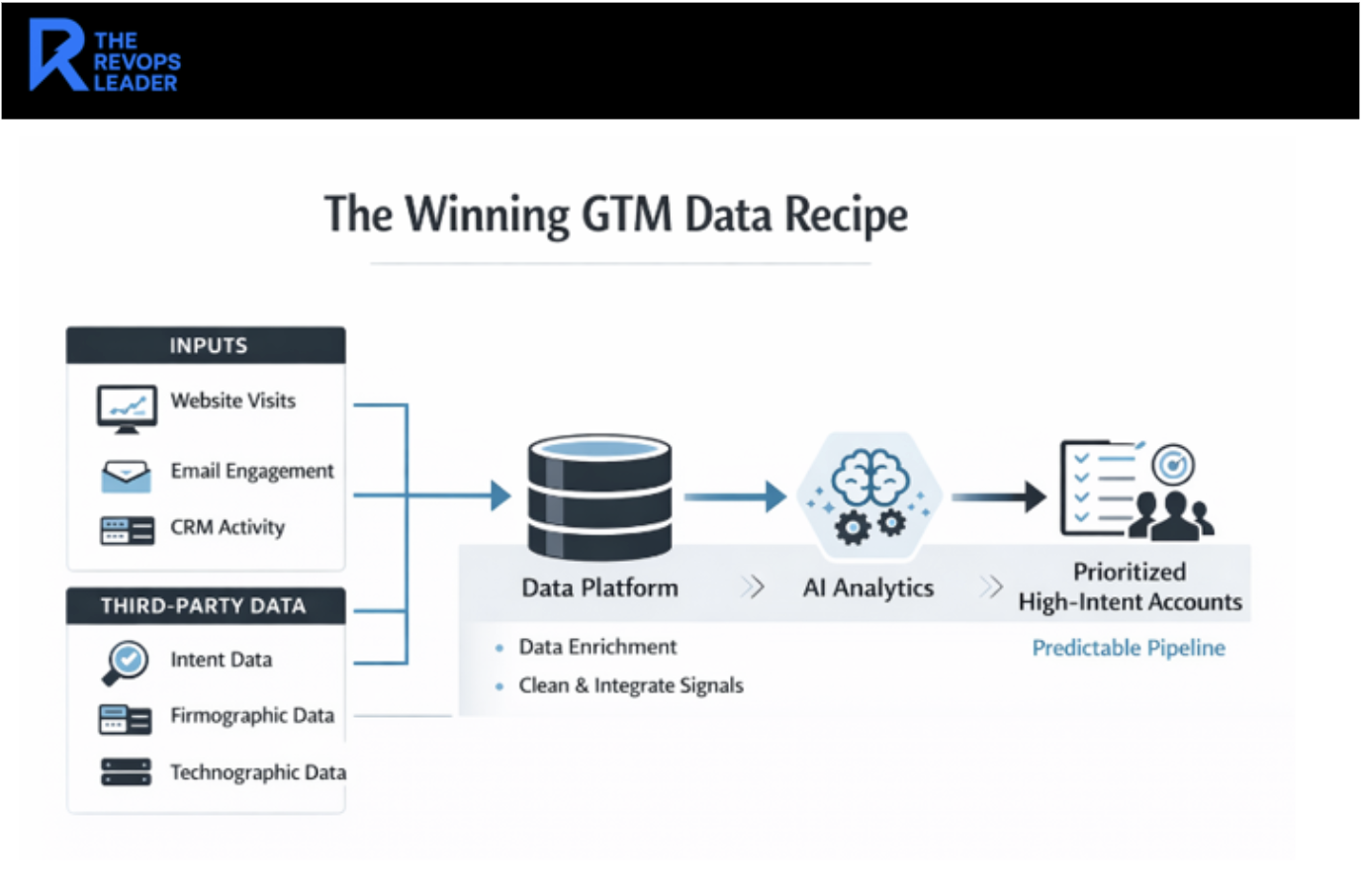
Combine first-party signals (website visits, CRM activity) with quality third-party intent data to create "data recipes" that identify high-probability accounts
Manoj Ramnani of SalesIntel and Mike Burton of Bombora sat down to discuss how the best go-to-market teams are building what they call "data recipes" (=specific combinations of signals that reliably identify accounts ready to buy).
The data quality imperative
AI is only as good as the data you feed it. If low-quality data flows into your AI-driven workflows, you're sending your frontline team in the wrong direction faster than ever before.
Before layering on automation, audit your existing data. Is it clean? Complete? Current? Your GTM efficiency depends on these fundamentals regardless of how sophisticated your tech stack becomes.
Building your data recipe
A "data recipe" is the specific combination of signals that correlate with closed-won deals for your business. It might include ICP firmographic fit, website visits in the last 60 days, third-party intent spikes, and technographic data showing competitor usage.
💡Different organizations have different winning recipes. Work backward from your closed-won accounts to identify which combination of 3-4 signals consistently predicted success.
First-party meets third-party
First-party intent includes behavioral signals from your owned properties – email engagement, CRM activity, website visits.
Third-party intent captures research activity happening outside your ecosystem, like when prospects read industry publications or download content about topics you solve.
The smartest teams layer these together to create a flywheel: use third-party intent to identify accounts showing buying signals, put ads in front of them, drive traffic back to your site, then capture that as first-party intent that flows into lower-funnel motions.
The bottom line
Build your data recipe by analyzing what signals correlated with your best wins, then ruthlessly prioritize accounts matching that profile. Clean data + layered signals = predictable pipeline.
2. RevOps 3.0: the evolution of RevOps from order-taker to systems builder
Webinar with RevOps Co-Op: Think Like a Product Manager, Build an AI-Ready RevOps Engine (12/29/25)
TLDR:
RevOps is evolving from reactive order-taker to strategic builder that ships systems, not just maintains them
Apply the Software Development Life Cycle (SDLC) – plan, discover, design, build, test, ship – to RevOps projects
Pendo's RevOps team used this approach with Agentforce to automate 4,300 quarterly support cases
Cass Ernst Faletto, Senior Director of Revenue Operations at Pendo, argues we've entered a new era of RevOps. She calls it "RevOps 3.0" and the defining characteristic is: builders win.
The evolution from order-taker to builder
RevOps 1.0 was tactical. You sat in spreadsheets, responded to sales leader requests, and made changes in Salesforce.
RevOps 2.0 brought strategic ownership. You started thinking about the full customer funnel, became a thought partner, and got invited into rooms where decisions happen.
RevOps 3.0 is about building. With AI tools now accessible, RevOps teams can actually build solutions themselves. The question isn't "how do we maintain systems?" It's "how do we ship them?"
How to apply SDLC thinking to RevOps
Cass borrowed a framework from product management called the Software Development Life Cycle. It works like this:
Plan: Define what you're trying to solve.
Discover: Interview stakeholders and gather qualitative data.
Design: Map out what the solution should look like.
Build: Create the actual automation or workflow.
Test: Validate it works.
Ship: Roll it out to the organization.
The key insight is that you can iterate through plan-discover-design multiple times before you ever build anything. This prevents wasted effort.
The Agentforce case study
Pendo's RevOps team receives ~4,300 support cases per quarter from sales reps. Things like merging accounts, changing hierarchy structures, updating website records. Repetitive, low-complexity tasks that eat up hours.
Using the SDLC approach, they analyzed historical cases with AI to identify patterns, then interviewed reps to understand frustrations. Four high-value, low-complexity use cases emerged. They built Agentforce automations that resolve issues in minutes instead of hours.
The result? Reps get faster resolutions. The RevOps team gets capacity back for strategic work.
The bottom line
The RevOps teams that will thrive in 2026 aren't the ones waiting for requests. They're the ones shipping solutions. Borrow the product management playbook: plan, discover, design, build, test, ship. Start with your highest-volume, lowest-complexity cases and build from there.
3. CROs often obsess over the wrong metrics (here’s how Intercom fixed it)
The Revenue Leadership podcast: Usage-Based Comp, AI, and the End of the SDR with Tyler Will, VP of RevOps @ Intercom (12/31/25)
TLDR:
Most revenue leaders focus on success metrics (revenue closed) while ignoring input metrics that actually drive results
AI literacy isn't optional anymore: CROs need to understand at least the basics of how AI products work
Tyler Will, VP of RevOps at Intercom, has spent three years rebuilding their go-to-market engine after shifting to AI-first products. His core message to RevOps leaders? Stop measuring only what happened and start instrumenting what drives outcomes.
The input metrics problem
Here's the scene Tyler describes: Your CRO stands up at sales kickoff and says "Close more bigger deals this year. Go get them." Everyone applauds. Nobody knows what to do next.
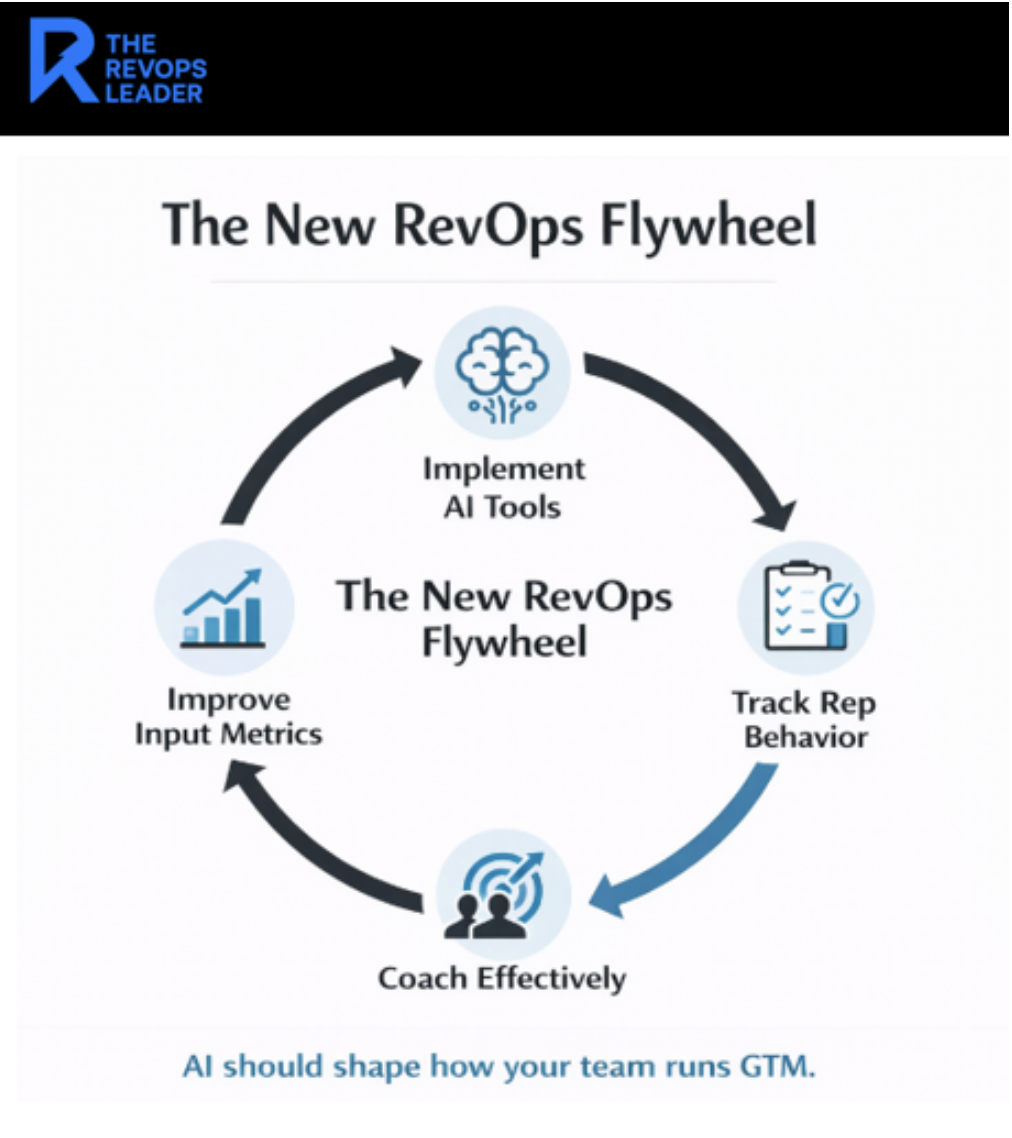
That's the problem with success metrics. They tell you what happened, not how you got there, or what to do about it. Tyler argues you need to understand the entire system: how much pipeline to generate, what that pipeline should look like, what signals indicate account readiness.
For example, instead of just measuring closed deals, track whether reps are having QBRs with the right accounts at the right cadence. That's an input metric you can actually coach on.
Comp plans for the consumption era
Intercom shifted from selling seats to selling AI resolutions. This broke their entire comp model. If a customer starts using more AI and spending more money, how does the rep get credit?
Their solution: Give reps MRR credit for usage overages without requiring them to force contract expansion conversations. This keeps reps’ incentives aligned with customer success rather than creating friction.
Tyler's four principles for comp plans:
Simple: reps can calculate their own earnings
Fair: top performers see upside
Instrumentable: you can track the behaviors you're rewarding
Tied to the right behaviors, not just outcomes
The AI literacy floor for revenue leaders
If you can't explain how your own AI product works, you're going to "look pretty stupid" in customer conversations. You need to understand concepts like RAG (retrieval augmented generation), how models get trained, and what the application layer does.
For internal AI tools, there's more flexibility. Your CRO doesn't need to know exactly how Clay works. But they should be embracing AI tools, sitting in on vendor demos, and understanding use cases. Those who don't will get passed by those who do.
The bottom line
Build a system you can actually look into and that allows you to measure inputs, not just outcomes. And get comfortable with AI; not just as a product feature, but as a way your team operates. The RevOps leaders who instrument the whole machine will outperform those who just watch the scoreboard.
Disclaimer
The RevOps Leader summarizes and comments on publicly available podcasts for educational and informational purposes only. It is not legal, financial, or investment advice; please consult qualified professionals before acting. We attribute brands and podcast titles only to identify the source; such nominative use is consistent with trademark fair-use principles. Limited quotations and references are used for commentary and news reporting under U.S. fair-use doctrine.
