
RevOps or GTM Engineering: Where Does the Future Belong?
Welcome to The RevOps Leader, where every week, we listen to dozens of ReVOps podcasts and extract the top actionable ideas. (For more context on these ideas, give the podcasts a listen)
In this issue:
The identity crisis: RevOps vs. GTM Engineering.
How Yotpo triages RevOps AI decisions.
The RevOps decision tree: when to hire, outsource, or buy a tool.
1. The identity crisis: RevOps vs. GTM Engineering
Webinar: Demystifying GTM Engineering - how does it drive growth? with Oren Greenberg - Growth marketing and GTM engineer advisor, Mahak Vedi - Founder at Revology Consulting, Tom Andrews - VP of GTM Ops at HiveBrite, and moderated by Nicola Anderson, The CMO Circle Co-founder (Dec. 5, 2025)
TLDR
GTM Engineering is emerging as a distinct role focused on technical automation, API stitching, and AI implementation, filling a gap traditional RevOps often misses.
A key differentiator is "creative laziness": if a task takes more than 15 minutes, a GTM Engineer builds a script or automation to handle it.
To audit your need for this role, look for manual data entry and "swivel-chair" processes between your marketing automation and CRM.
While traditional RevOps often focuses on strategy, process, and business intelligence (reporting), GTM Engineering leans heavily into the technical "how."
As tech stacks exploded, many RevOps teams focused on soft skills and basic CRM administration, leaving a gap in deep data architecture and automation. GTM Engineering fills this by using code (Python, APIs) to stitch tools together, whereas traditional RevOps might rely on native integrations or manual work.
How the roles actually differ
Oren Greenberg analyzed 1,380 LinkedIn profiles to compare RevOps and GTM engineering skills. The findings are revealing:
RevOps professionals over-index on business intelligence and reporting, process operations, strategic planning, and CRM expertise.
GTM engineers over-index on AI implementation, outbound sales execution, and demand generation.
The pattern makes sense: GTM engineers tend to work at earlier-stage startups where execution speed matters most. RevOps tends to appear in mid-market and enterprise companies where strategy and reporting become critical. The controversy comes from the overlap – workflow automation skills appear nearly equally in both roles.
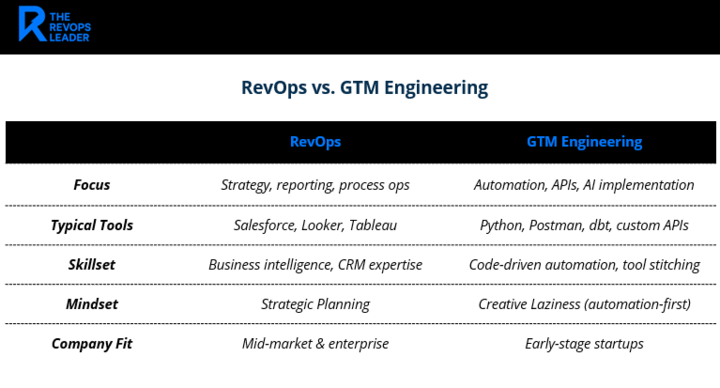
The "Creative Laziness" Mindset
The defining characteristic of this new technical operator is a mindset of "creative laziness." This doesn't mean avoiding work; it means refusing to do manual work that a machine could do.
If a process – like enriching a lead, transferring notes from a call recording to a CRM field, or researching a prospect – takes a human more than 15 minutes, it is a candidate for engineering.
Mahak Vedi shared a case study that illustrates the RevOps opportunity: A client using Salesloft and HubSpot had data that didn't sync properly. Simply fixing that integration saved 50 hours per month—more than a full work week—because reps stopped clicking between tabs and manually reconciling information.
For RevOps leaders, this is a wake-up call. Are you hiring more analysts to manage manual data, or are you building the architecture to automate it? The goal is to reduce the "cost of revenue" by eliminating the human hours spent on low-value data movement.
How to Audit Your Need for Engineering
You might not need to hire a "GTM Engineer" if you upskill your current RevOps team, but you do need the capability. To assess your gap, map out your sales process step-by-step. Look specifically for "swivel-chair" moments, where a rep has to alt-tab between LinkedIn, a sales engagement tool (like Outreach or Salesloft), and Salesforce to copy-paste information.
If you find your team spending hours manually enriching data or fixing formatting errors between systems, you have a GTM Engineering problem. The solution isn't more process documentation; it's better data architecture.
The Bottom Line
"GTM Engineer" might just be a trendy title, but it signals a real shift: the future of RevOps is technical. If your team cannot write scripts or manage complex API automations, you risk becoming a strategic bottleneck rather than a growth engine.
2. How Yotpo triages RevOps AI decisions
GTM Hackers podcast, Episode: How Yotpo is Rewriting the GTM Playbook for High-Performing Growth Teams, with Yuval Bresler, Director of GTM Ops & Analytics at the e-commerce reviews platform (Dec. 4, 2025)
TLDR:
Categorize AI projects into "High Code" (assign to Devs), "Low Code" (RevOps), and "No Code" (End Users) to manage chaos.
RevOps managers – not dedicated GTM engineers – should own most AI workflows because they know the problems
The current challenge for RevOps leaders is operationalizing AI without creating a "Frankenstein" monster of disconnected tools and rogue automations.
The role of RevOps is shifting. It’s no longer just about being the builder; it’s about becoming the governor of a democratized building process. To manage this, Yuval proposes a three-tier framework for AI ownership:
1. High Code (Owned by Developers/GTM Engineers) These are complex integrations involving LLMs directly into your product or core systems. This requires actual engineering resources. RevOps’ role here is to provide the business case and data provisioning, but you aren't writing the code. Example: Building a system that auto-categorizes every incoming Customer Success email and drafts responses based on historical data.
2. Low Code (Owned by RevOps) This is the sweet spot for Operations. Using tools like N8N (a workflow automation tool similar to Zapier but more powerful) or Clay, RevOps can build sophisticated agents and data enrichment flows. You understand the data structure and the business logic, so you build the "plumbing" that connects disparate systems.
3. No Code (Owned by End Users) This includes custom GPTs or simple copilots. Here, the RevOps mandate is strictly governance. You set the guardrails – what data can be shared, what processes can be touched – and then you get out of the way. Let the Product Marketing Manager build their own "Battlecard Bot" using a custom GPT. You don't need to build that for them; you just need to ensure they don't leak customer PII (Personally Identifiable Information) while doing it.
Real-World Example of “low code” success: Solving Parent-Child Mapping
For years, Yotpo struggled with mapping Parent-Child account relationships (e.g., mapping various brands to one conglomerate). They tried manual offshore teams and expensive data dumps, but nothing stuck.
Using N8N, a team member built a workflow that:
Pulled account data from Salesforce into Google Sheets.
Used ChatGPT to research public records and identify corporate hierarchies.
Wrote the correct parent-child relationship back into Salesforce.
Notified the Account Manager.
A problem that persisted for three years was solved with a few hours of low-code work.
3. The RevOps decision tree: when to hire, outsource, or buy a tool
Boardroom RevOps podcast, Episode: Getting RevOps Work Done: Teams, Tools, and Community (Dec. 5, 2025)
TLDR:
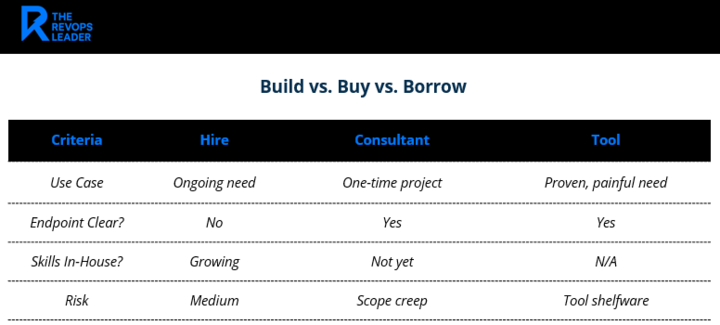
Use consultants for defined deliverables with clear endpoints, not for ongoing work you'll need to maintain.
Only buy a tool when you have a process that’s repeatable, and the pain is significant enough to justify the investment.
Josh Janes has done RevOps at hypergrowth companies like DocuSign and Splunk. He's seen messy CRMs, broken forecasts, tool sprawl, and the eternal question: should we hire, outsource, or throw a tool at this problem? It depends on whether you're solving a defined problem or building ongoing capability.
The consultant decision framework
Consultants work best when you can define the deliverable. "We need our CRM restructured" is a good consulting project – it has a clear endpoint. "We need ongoing analytics support" is usually better as a hire, because you'll need that capability indefinitely.
Josh's test: can I tell when you've delivered and we're done? If yes, consider consulting. The exception is specialized expertise you'll only need once. If you're implementing a CPQ system and nobody on your team has done it before, bringing in an expert for that specific project makes sense.
When tools actually make sense
The classic mistake: buying a tool to solve a process problem. Josh's checklist before any tool purchase: Do you understand your current process? Is that process repeatable across your team? Is the pain significant enough to justify the cost and implementation effort?
Start with a manual MVP. If you're thinking about a forecasting tool, build it in Google Sheets first. Prove the process works and people will use it. Then buy the tool to enforce compliance and scale. This approach saves you from expensive tools that solve the wrong problem, or tools that nobody actually uses.
The bottom line
Your first RevOps priority is always the same: can you confidently forecast revenue? Everything flows from there. You need someone owning CRM integrity (the source of truth) and someone owning analytics (the ability to model and predict). Build those foundations with full-time hires. Use consultants for defined projects with clear endpoints. Buy tools only when you've proven the process manually and the pain justifies the investment.
Disclaimer
The RevOps Leader summarizes and comments on publicly available podcasts for educational and informational purposes only. It is not legal, financial, or investment advice; please consult qualified professionals before acting. We attribute brands and podcast titles only to identify the source; such nominative use is consistent with trademark fair-use principles. Limited quotations and references are used for commentary and news reporting under U.S. fair-use doctrine.
