
Your GTM Isn’t a Process. It’s Code. Start Treating It That Way
Welcome to The RevOps Leader, where every week, we listen to dozens of ReVOps podcasts and extract the top actionable ideas. (For more context on these ideas, give the podcasts a listen)
In this issue:
Treat your GTM like software code that can be tested and iterated
What I would do if I was starting in RevOps today…
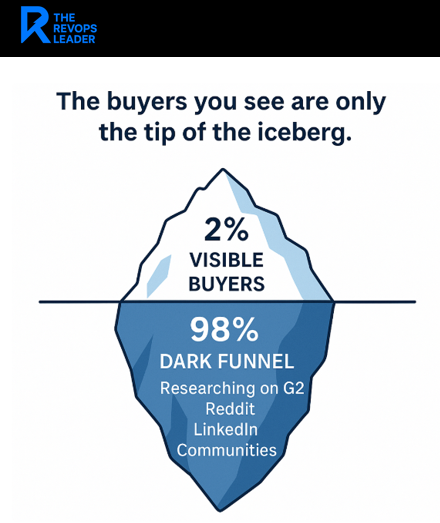
Going after the “dark funnel”: the 98% of buyers who don’t fill out your forms
1. Treat your GTM like software code that can be tested and iterated
Xgrid Talks Podcast by Xgrid, Episode: GTM Engineering Masterclass | Signals, Automation & AI with Everett Berry, Head of GTM Engineering at Clay (Nov. 26, 2025)
TLDR:
Stop treating sales ops as a "people process" and start treating it like software code with releases and iterations.
The modern stack needs four distinct layers: System of Record, Enrichment, Action, and Analytics.
Modern GTM requires custom signals (you can’t use “recently changed jobs” anymore).
What is GTM Engineering?
Most revenue operations teams treat their sales process as a series of human behaviors supported by tools. Instead, you should treat GTM like a software product: design it, build it, ship "releases" (new campaigns or workflows), and use analytics to debug it.
A "GTM Engineer" is a technical operator who connects APIs and builds systems that execute the sales motion automatically.
Instead of asking a rep to "research the prospect," you write code (or use no-code tools) to waterfall data providers until that research is done for them.
The Four-Component Stack
To build this engine, you need four specific components. Many RevOps teams try to buy "all-in-one" tools, but a modular stack often works better:
System of Record: Where the data lives (Salesforce, HubSpot, or increasingly, Data Warehouses).
Enrichment Engine: Tools that waterfall data to fill in gaps (Clay).
Action Layer: Where the outreach happens (Outreach, Salesloft, Apollo).
Analytics: Tracking what happened (Gong, CRM reporting).
The "Green Dumpster" Signal
The most actionable insight is moving beyond generic data (like "Job Changes") toward custom signals unique to your business.
Berry shares an example of a waste management company. Instead of just emailing every business in a zip code, they used AI to scan Google Street View images of target addresses. If the AI detected a dumpster that wasn't green (their brand color), it flagged the account as a prospect.
For RevOps, this changes the game. Your job isn't just to buy ZoomInfo lists; it's to find the creative, technical signal that proves a specific need – like an FAA violation, a specific technology install, or a hiring spike in a niche role.
Don't Spam the Signal
A common mistake Ops teams make is setting up a trigger: Signal happens → Send email immediately.
This creates noise. Instead, use signals to build a composite "Heat Score." If an account visits the website, likes a LinkedIn post, and hires a VP of Sales, the score goes up. Only when the score hits a threshold do you trigger the expensive sales outreach.
The Bottom Line
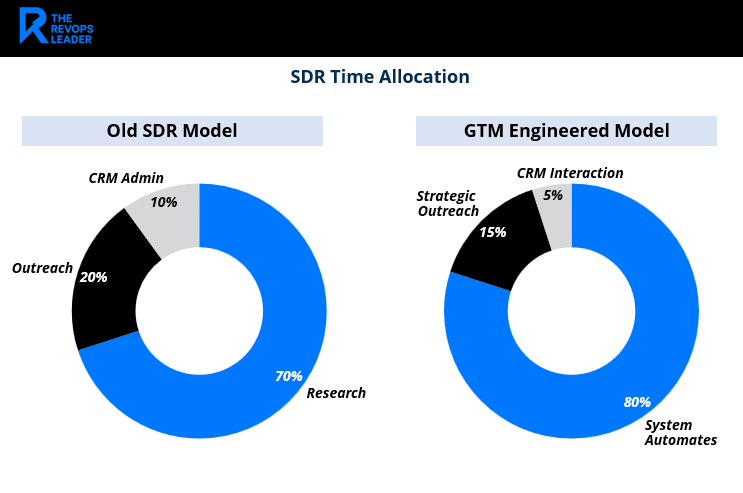
Stop asking your SDRs to be data researchers. Your goal as a RevOps leader is to engineer a system where 80% of the research and qualification happens automatically via data waterfalls, so your humans only engage when an account is actually "hot."
2. What I would do if I was starting in RevOps today…
The RevOps Loop podcast with Stjepan Grcic and Maarten Bovend’aerde, Episode: If You Started in RevOps Today, What Would You Focus On First? (Nov. 26, 2025)
TLDR:
Start building simple apps and automations for hands-on experimentation
How to become invaluable: One tech-savvy, business-savvy person can now replace entire marketing teams IF they understand how systems work vs individual tools.
The ability to quickly evaluate tools (not just use them) is becoming a highly valued skill.
Maarten and Stjepan’s paths to RevOps were different – one came through web development and Facebook ads, the other through sales and lead scraping – but their advice converges on principles that matter even more in the AI era.
Make it real or don't bother
Stjepan recalls spending $20 on early Facebook ads when nobody else was doing it, and getting a call to manage $1,000/month a week later. That hands-on experimentation taught him more than any course could.
Their advice for newcomers: build something real, even if it's small.
Start a newsletter and learn to segment subscribers.
Create an app on Lovable and spend $100 promoting it on Reddit.
Connect it to a free CRM and build automations.
The investment forces you to care about results, not just concepts.
The one-person team advantage
AI-savvy individuals who understand marketing concepts, CRM architecture, and system integration are replacing entire teams.
You don't need to be an expert in every platform. You need to understand how CRMs work (objects, relationships, data flow), how campaigns are structured (groups, ad sets, audiences), and how attribution connects everything.
RevOps people are now running complete marketing operations solo: strategy, creative, implementation, optimization, and attribution modeling. The skill that makes this possible isn't tool mastery; it's systems thinking combined with AI fluency.
The bottom line
Stop trying to master every new tool; start understanding how systems work together. The most valuable RevOps professionals will be those who can evaluate tools quickly, integrate them thoughtfully, and translate technical capabilities into business outcomes for any audience.
3. Going after the “dark funnel”: the 98% of buyers who don’t fill out your forms
Webinar: Dark Funnel Marketing & Deep Personalization at Scale by Ritesh Osta from Insightstap (Dec. 2, 2025)
TLDR:
98% of your market is in the "Dark Funnel" and will never fill out a form; you must detect them proactively.
Shift from a contact-based view (CRM) to a unified Customer Data Profile (CDP) that tracks account behavior.
Use the "Personalization Logic Tree" to scale outreach: Role + Company + Signal + Enrichment.
The Problem with Inbound
The traditional funnel assumes a linear path: Awareness → Interest → Form Fill. This model is broken. Buyers do 80%+ of their research before talking to sales, often on channels you can't easily see (communities, dark social, third-party review sites). If you wait for a form fill (Inbound), you are fighting over the 2% of the market that is actively raising their hand – a "red ocean" of competition.
The DARK Framework
To operationalize the other 98%, follow the DARK framework:
Detect: Identify hidden intent (hiring spikes, ad clicks, G2 reviews, website visits).
Augment: Don't just rely on a name; enrich with technographic and firmographic data (e.g., "They use HubSpot and just raised Series B").
Reach: Automate multi-channel outreach based on those signals.
Kaizen: Continuous improvement of the feedback loop.
From Contact to Unified Profile
A key insight for RevOps is the data structure shift. Traditional CRMs are contact-centric. Modern "Dark Funnel" operations require a unified Customer Data Profile (CDP).
This profile aggregates signals, such as: This account visited the pricing page + This specific contact opened an email + The company posted a job for a React Developer.
RevOps needs to build systems that ingest these disparate signals and present them as a single view of account intent.
The Personalization Logic Tree
How do you scale this without an army of SDRs? You use a logic tree for your automation:
Role: (e.g., VP of Finance)
Company Context: (e.g., Enterprise, Fintech)
Signal: (e.g., Hiring spike)
Enrichment: (e.g., Uses NetSuite)
Resulting Message: "Saw you're hiring for Finance roles [Signal] at [Company]. Since you're using NetSuite [Enrichment], many VPs of Finance [Role] find that..." This allows for "Deep Relevance" at scale, rather than just inserting {{First_Name}}.
The Bottom Line
Inbound is not enough. RevOps leaders need to build a "Night Vision" engine that detects intent signals outside of form fills. Shift your metrics from "Leads Generated" to "Accounts Detected" to capture the demand that is researching you in the dark.
Disclaimer
The RevOps Leader summarizes and comments on publicly available podcasts for educational and informational purposes only. It is not legal, financial, or investment advice; please consult qualified professionals before acting. We attribute brands and podcast titles only to identify the source; such nominative use is consistent with trademark fair-use principles. Limited quotations and references are used for commentary and news reporting under U.S. fair-use doctrine.
