
Your CFO Is the Key to RevOps Survival
Welcome to The RevOps Leader, where every week we listen to dozens of ReVOps podcasts and extract the top actionable ideas. (For more context on these ideas, give the podcasts a listen).
In this issue:
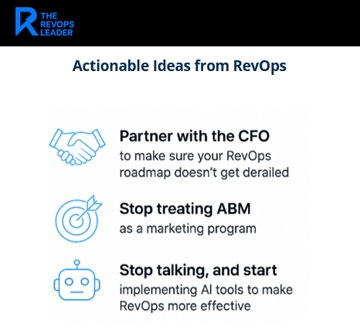
Partner with the CFO to make sure your RevOps roadmap doesn’t get derailed
Stop treating ABM as a marketing program
Stop talking, and start implementing AI tools to make RevOps more effective
1. Partner with the CFO to make sure your RevOps roadmap doesn’t get derailed
RevOpsAF Podcast, Episode: Why RevOps Roadmaps Fail and How To Fix It (Oct. 15, 2025)
TLDR:
The CFO is your most important ally: they whisper in the CEO's ear and control budget decisions that determine your survival
Use math, not opinions, to prioritize initiatives and tie everything back to revenue impact the CRO can celebrate
You built a careful roadmap. You got buy-in from stakeholders. And then three months later, it's completely off the rails because the CRO has a new priority, marketing wants something urgent, and you're back to being a ticket taker. This pattern destroys RevOps teams everywhere, but Jacki Leahy has cracked the code on why it happens, and how to fix it.
The CFO is your secret weapon
Jacki's solution is brilliant: team up with the CFO. "If the CFO is on your side, you've got the tiger by the tail." The CFO usually has the CEO's ear. In smaller companies especially, the CFO is often the person whispering strategic advice while the CEO picks up on vibes.
This makes the CFO your keystone for job security and effectiveness. When you align your work with what the CFO cares about – efficient capital deployment, predictable revenue, measurable ROI – you become strategic instead of tactical. You're not just implementing requests; you're driving outcomes that show up in board meetings.
Stop looking outward for what to work on
Too many RevOps professionals look to stakeholders to determine priorities. Someone screams loud enough, and their project jumps to the top. But Jacki flips this: "You can't be looking outward to see what you should be doing. You are the one. You are Neo. This is your permission slip."
Your job is to have an opinion backed by math. Not what you think or what you prefer but what the data says will actually move the revenue engine forward. "You are fighting on behalf of the revenue engine as a system, and that is the end-all be-all because ain't nobody got a job if the revenue engine is sick."
The math that wins arguments
When stakeholders push for their priorities, you need to punch them in the nose with bottom-line-upfront math. Here's Jacki's example: The CRO wants to change opportunity stages. But the sales team is drowning in unqualified leads and complaining they have to source too much of their own pipeline.
The wrong approach: "Don't you think we should fix lead routing first?" The right approach: "You're fighting for stages. Your team is yelling for pipeline sourcing. Here are the actual numbers. If we improve this conversion rate by X%, we'll save this much selling time and generate this much ARR that you can celebrate at the board meeting. This is what you want. Here's the math."
When you tie initiatives to specific revenue outcomes the CRO cares about, you're speaking their language. The CFO appreciates it too because you're thinking like an investor, not a task executor.
Why priorities shouldn't be plural
"The word priority comes from Latin meaning to value over everything else," Jacki noted. "This word should not be pluralized." You can't fight the war on all fronts. You have to identify the key constraint in the revenue engine and swarm it with focus.
For smaller companies especially, roadmaps need flexibility built in. You might plan to fix the sales process, but if churn suddenly spikes, that becomes the constraint. It's okay to pivot because losing customers makes any sales process improvement worthless. The key is making these pivots strategically based on data, not whoever yelled loudest.
2. Stop treating ABM as a marketing program
A-Round Podcast, Episode: Actionable Intelligence: How Lean Teams Build High Impact ABM Programs! (Nov. 11, 2025)
TLDR:
Most companies assign all ABM work to marketing, but this creates bottlenecks and misalignment.
Build your ABM program’s foundations first and THEN explore which ABM platform to buy.
Christine Carrig, a 20-year marketing veteran who's built systems for multiple startups, challenges the conventional wisdom that successful ABM requires expensive platforms like 6sense or Demandbase. Her argument? Most early-stage companies skip the foundational work and jump straight to tooling, which leads to confusion, wasted budget, and team frustration.
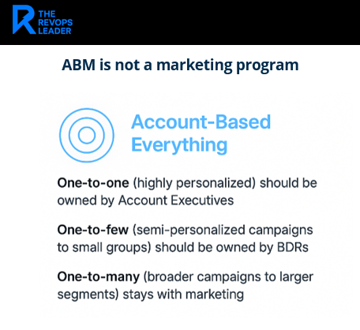
ABM isn't account-based marketing, it's account-based everything. Carrig suggests dividing ABM into three strategies with clear ownership
One-to-one (highly personalized) should be owned by Account Executives working strategic accounts.
One-to-few (semi-personalized campaigns to small groups) should be owned by BDRs.
One-to-many (broader campaigns to larger segments) stays with marketing.
This distributes the work and gives each team member "pride of ownership" over their accounts.
For example, if a BDR is responsible for one-to-few outreach to 15-20 accounts, they can request email templates or landing pages from marketing, but they own the relationship and the strategy. This prevents the common scenario where "marketing beats the drum all the time" while sales waits passively for leads.
Build three foundational disciplines before buying tools
Most companies immediately want to buy ABM platforms, but they're not ready. Carrig recommends building three foundations first:
Team alignment: Get sales, marketing, and BDRs working together with shared definitions of target accounts and outreach cadences. Learn how each team member communicates and what data they need before adding complexity.
Visibility and performance metrics: Set up basic dashboards to see account-level activity, contact-level engagement, and team performance. Kerry specifically mentions using HubSpot's default enterprise reports (included in base pricing) which show things like: How many contacts exist per account? When was the last sales touch? Which assets are performing?
Operational processes: Build the data instrumentation and field structure you'll need for tracking. This seems boring, but Kerry insists it's critical: "You don't want to go back in time and have to re-instrument your tracking systems" once you start seeing success.
Start with HubSpot, not enterprise ABM platforms
Carrig says: "I've launched programs within HubSpot on their free tooling, not even paying for it." HubSpot's basic account includes 100 target accounts for ABM, intent data visibility (showing when target accounts visit your site), and account-level reporting.
She specifically recommends against buying platforms like 6sense, Terminus, or Demandbase until Series B, when you have a larger team to manage the complexity.
Her reasoning: "You're going to throw another tool at them to learn and manage. There's a lot of grumbling." Sales teams are already overwhelmed. Adding tools creates noise when you should be focused on learning what works.
Give it time: commit to accounts for 6 months minimum
Perhaps Carrig’s most counterintuitive advice: once you choose 5-6 target accounts, stick with them for at least six months. "It can take 6-9 months to get any type of activity on that account.”
RevOps teams often want to optimize quickly, but ABM requires patience. You need enough time to test different approaches, see which content resonates, and build relationships. Switching accounts after two months means you never learn what actually works.
3. Stop talking, and start implementing AI tools to make RevOps more effective
Flashgrowth Podcast, Episode: How AI and RevOps Are Changing GTM (Nov. 13, 2025)
TLDR:
AI in RevOps isn't about replacing reps, it's about efficiency gains through tools like Clay, HubSpot's prospecting agents, and conversational intelligence
Bringing sales and marketing ops together unlocks growth by creating a complete picture of the customer journey
RevOps leaders need to embrace AI tools and implement them, not just talk about them on LinkedIn
Nick Golubitsky is VP of Revenue Operations at GreenSlate. He's not selling AI hype. He's showing how AI tools are creating measurable results in his GTM operations today. Here's what's actually working.
The real AI stack that's driving results today
Nick walks through a live enterprise lead campaign that shows how AI tools work together in practice. The workflow starts with Google Ads driving traffic. When someone converts, Clay enriches the lead data automatically, finding job titles, company information, and relevant context.
That enriched data flows into HubSpot, where prospecting agents take over. These agents don't just send generic emails. For example, if someone won an Emmy last year, the agent finds that information and includes a personalized congratulations in the follow-up email.
The result? Emails that don't read like autoresponses. Conversational intelligence tools then analyze every interaction, flagging opportunities and tracking engagement. This isn't future tech; it's running in production right now.
The key insight: AI doesn't write better emails than good salespeople. But it processes information in seconds that would take humans hours. That speed creates personalization at scale.
Why sales and marketing ops had to merge into RevOps
When Nick started in operations, he was just the Salesforce admin. Then he picked up sales ops responsibilities. Then marketing ops. Each time, he saw part of the picture but not the whole story.
The breakthrough came when everything merged into RevOps. Suddenly, you could see the complete customer journey – from first touch through close and beyond. Data that sat in silos became connected. Marketing could see which campaigns actually drove closed deals, not just MQLs.
This alignment isn't about org charts. It's about seeing patterns you can't see when teams operate independently. When marketing, sales, and operations share the same data and goals, they can actually optimize for revenue instead of vanity metrics.
Stop talking, start implementing
Nick is blunt about the current state of RevOps discourse on LinkedIn: too much theory, not enough execution. He sees posts about "I made this Zapier flow and it did XYZ – comment to get it" without proof it actually works.
His advice for RevOps professionals starting today: be more confident. Don't wait for permission to test things. Run experiments, gather data, then present the results to leadership. If they're not interested, skip a level and show someone who cares.
AI tools have dramatically accelerated this test-and-learn cycle. What used to take a week now takes 10 minutes. You can explore tools for free, get sandbox access from vendors, and prove value before asking for budget.
The future RevOps leader isn't the one with the most certifications, it's the one who implements fastest and proves ROI clearly.
Disclaimer
The RevOps Leader summarizes and comments on publicly available podcasts for educational and informational purposes only. It is not legal, financial, or investment advice; please consult qualified professionals before acting. We attribute brands and podcast titles only to identify the source; such nominative use is consistent with trademark fair-use principles. Limited quotations and references are used for commentary and news reporting under U.S. fair-use doctrine.
