
The Biggest Revenue Lever Most Teams Ignore
Welcome to The RevOps Leader, where every week, we listen to dozens of ReVOps podcasts and extract the top actionable ideas.
Learn AI from RevOps builders. We're launching AI Skills workshops to help you understand trends, build custom tools, and automate workflows (taught by the CTOs / Heads of AI building AI tools in your industry, not trainers).
Reply “Skills” to save your spot as a Founding Member (the first 100 get 50% lifetime discount).
In this issue:
The three-legged stool that separates VP-level RevOps leaders from everyone else
How to build a high-converting prospect database at a fraction of the cost
Low-cost plays to reactivate frozen pipeline deals
1. The three-legged stool that separates VP-level RevOps leaders from everyone else
Boardroom RevOps podcast: The "3-Legged Stool" to Becoming VP of RevOps, with Jeff Wadholm, SVP of RevOps at MeridianLink (Feb 6, 2026)
TLDR:
Senior RevOps leaders need three distinct capabilities: tactical expertise, strategic thinking, and leadership acumen. Weakness in any one limits career advancement.
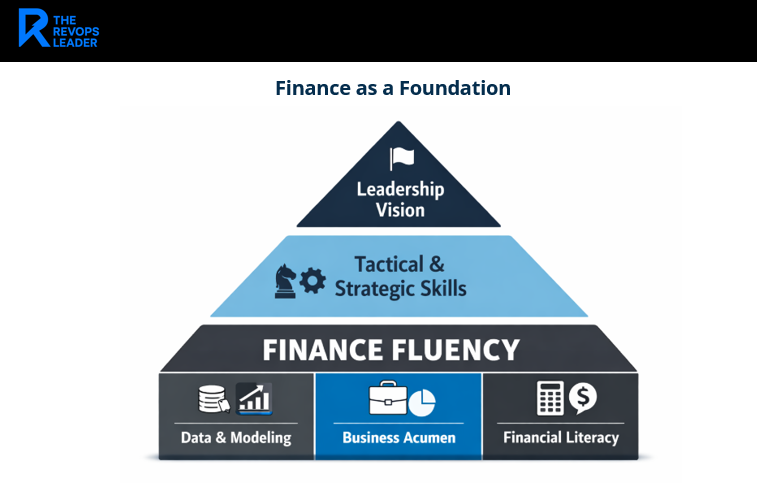
Finance fluency is foundational because it helps you connect go-to-market work to business outcomes and speak the language executives actually care about.
The fastest way to grow your team isn't asking for more headcount. It's demonstrating incremental value so clearly that more resources become an obvious investment.
Jeff Wadholm was one of the first people on LinkedIn with a "Revenue Operations" title. After 20+ years in the space and SVP roles at multiple companies, he's developed a clear mental model for what separates RevOps professionals who plateau at mid-level from those who make it to the executive table.
The three legs you need to stand on
Wadholm describes senior RevOps success as a three-legged stool.
The first leg is tactical mastery. You need to walk into any company and immediately understand the right metrics, KPIs, systems, and processes. This isn't measured in years of experience but in repetitions and scar tissue from different situations you've navigated.
The second leg is strategic thinking. This means understanding how go-to-market strategy connects to the broader business: seller headcount decisions, marketing automation, customer experience flywheels, and value creation plans. Many RevOps professionals get stuck because they're excellent at the tactical work but can't translate it into strategic conversations with CROs, CFOs, and board members.
The third leg is leadership acumen. This includes finding and developing talent, managing competing priorities, and keeping your team aligned while the business pulls in multiple directions. RevOps is uniquely challenging here because, unlike sales or engineering, there often isn't someone more senior in the organization who has done your exact job before.
Why finance fluency matters more than you think
Wadholm spent his first five years in finance before transitioning to sales operations, and he credits this foundation as a key differentiator.
Finance teaches you two things:
How to connect tactical work to business objectives without having an "allergic reaction" when leadership pushes priorities that don't feel immediately aligned with sales team empathy.
Deep comfort with modeling, data, and spreadsheets – still the backbone of RevOps work even with modern tools.
His advice for RevOps professionals without a finance background: dive deep anyway. Take courses, learn the concepts, understand how annual planning and value creation plans actually work.
How to teach people to treat you strategically
Think of it like the difference between being in a batting cage and being a golfer.
In a batting cage, you're reacting to whatever comes at you – swing, swing, swing. That's tactical RevOps.
A golfer, however, assesses the situation, picks the right club, reads the wind, takes practice swings, and then executes deliberately.
"We teach people how to treat us," Wadholm explains.
If you only respond to urgent requests and deliver reports, you'll be treated as a tactical resource.
If you bring strategic insights unprompted, connect your work to value creation, and position yourself as a thought partner to executives, they'll treat you accordingly.
Growing your team the right way
When asking for headcount, Wadholm sees two very different conversations. One sounds like: "We're drowning in work, we need more people." The other sounds like: "Here's the demonstrated value we've delivered. One more incremental headcount means this much more incremental value." The second conversation is dramatically more effective with CFOs and leadership teams.
The bottom line
Your background doesn't determine your ceiling in RevOps. Whether you came from finance, sales, marketing, or enablement, the path to senior leadership runs through the same three-legged stool: tactical expertise, strategic thinking, and leadership capability. Audit yourself honestly against all three, and if one leg is shorter than the others, that's where to focus your energy in 2026.
2. How to build a high-converting prospect database at a fraction of the cost
Webinar: How to get 10% of your target accounts to a meeting with AI + ABM (Feb 1, 2026)
TLDR:
Using a "waterfall" approach with multiple data providers can cut database costs by 75% while achieving 80%+ coverage
AI tools like Gemini Deep Research can automate account research that used to take hours
Template-based email personalization outperforms fully AI-generated messages
Building a quality prospect database with tools like ZoomInfo can cost tens of thousands of dollars annually. But there's a smarter way to get better coverage at a fraction of the price.
The waterfall enrichment approach
Instead of relying on a single expensive data provider, modern ABM teams are "waterfalling" through multiple sources. The process works like this: start with a base list from Apollo (which has a generous free tier), then layer in mobile number enrichment from tools like Prospeo and catch-all email verification from Enrich.ly.
The result? Teams report achieving 75-80% mobile number coverage at 3-4x lower cost than traditional enterprise data providers. For a RevOps team managing thousands of target accounts, this can mean saving $20,000+ annually.
Using AI for account research
Gemini Deep Research can analyze a company's recent press releases, leadership changes, technology stack, and competitive positioning in minutes rather than hours.
The key is writing highly specific prompts. Instead of asking for "information about Company X," successful teams prompt for persona-specific insights: "What challenges would a VP of Operations at a $50M manufacturing company face when evaluating pricing software?" This produces research that actually informs personalized outreach.
Template-based personalization beats full AI generation
Here's a counterintuitive finding: emails written entirely by AI perform worse than template-based emails with AI-generated fill-in sections.
The winning formula is a human-crafted email structure (icebreaker, account insight, problem alignment, social proof, call-to-action) where AI fills in the personalized research components.
The reason? Fully AI-generated emails often lack the strategic intent and conversational flow that experienced salespeople bring. Templates maintain that human architecture while AI handles the research-heavy lifting.
The bottom line
RevOps teams can dramatically reduce database costs by implementing a multi-source enrichment workflow and using AI for research rather than complete message generation. The combination delivers better data coverage and more effective personalization than expensive single-vendor solutions.
3. Low-cost plays to reactivate frozen pipeline deals
ABM Bootcamp 2026 session: Re-Activating Frozen Deals - Stefan Repin (Feb 6, 2026)
TLDR:
60% of pipeline often sits frozen, stranding your customer acquisition costs
Low-budget reactivation tactics like industry pattern posts and peer roundtables outperform expensive gifting for deals under $50K ACV
Localization matters: what works in Latin America (relationship-first) fails in Germany (case study-driven)
Stefan Repin, an ABM specialist with 10 years of experience, estimates that 60% of typical B2B pipeline sits frozen at any given time. That's significant customer acquisition investment stranded in stalled deals.
Why deals freeze (and what to do about it)
The root causes are predictable: sales jumped to solutions before proper discovery, timing shifted internally, champion energy faded, or buyers simply felt "sold to" rather than helped. Generic check-ins ("Hey, did you review the deck?") only make it worse.
The key insight? For deals under $50K in annual contract value – which represents the majority of B2B SaaS – expensive tactics like private dinners or Formula 1 experiences don't pencil out. You need low-cost, high-perceived-value approaches.
Three tactics that work for smaller deals
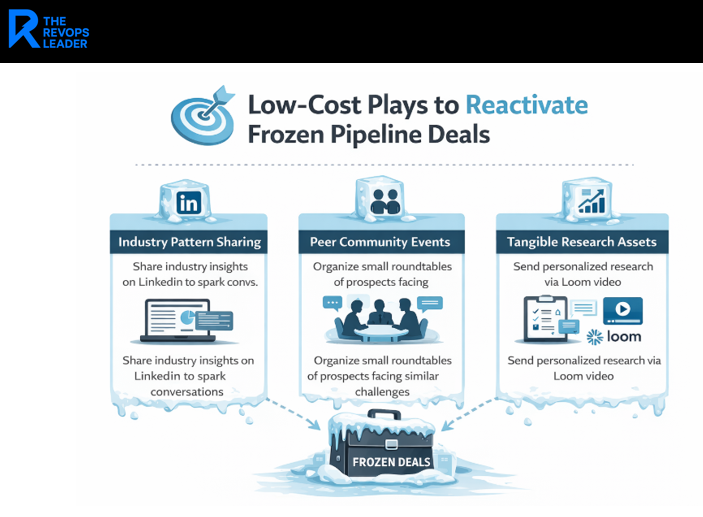
Industry pattern sharing: Publish a LinkedIn article analyzing a trend affecting your target accounts, then tag relevant decision-makers. You're not selling – you're offering valuable perspective. Track success through profile views, connection requests, and direct messages from target accounts.
Peer community events: Organize small roundtables where prospects can discuss shared challenges with other industry peers. One pharmaceutical company reactivated a frozen account by hosting a "support group" brainstorming session. The key: bring a neutral facilitator and make it about peer learning, not product pitches.
Tangible research assets: Create mini-playbooks, market research reports, or competitive audits featuring the target account's industry. Send via Loom video with a personalized walkthrough. Including competitors in the research adds an ego element that increases engagement.
Localization is critical
Reactivation tactics must match cultural expectations.
In Latin America, Stefan found success with personalized gifts emphasizing family values ("Mi familia, tu familia").
In Germany, formal case studies and peer validation drove results – no gifts needed.
In Asia, creative group-oriented approaches worked: one team sent a custom cake with the buying committee's photo, instructing them to "only eat when everyone gathers at lunch." It forced the group to reconvene, and they signed the contract.
The bottom line
Frozen pipeline doesn't require expensive reactivation tactics. For most B2B deals, low-cost approaches like industry insights, peer events, and personalized research deliver better ROI, but only when localized to match your buyers' cultural expectations.
Disclaimer
The RevOps Leader summarizes and comments on publicly available podcasts for educational and informational purposes only. It is not legal, financial, or investment advice; please consult qualified professionals before acting. We attribute brands and podcast titles only to identify the source; such nominative use is consistent with trademark fair-use principles. Limited quotations and references are used for commentary and news reporting under U.S. fair-use doctrine.
